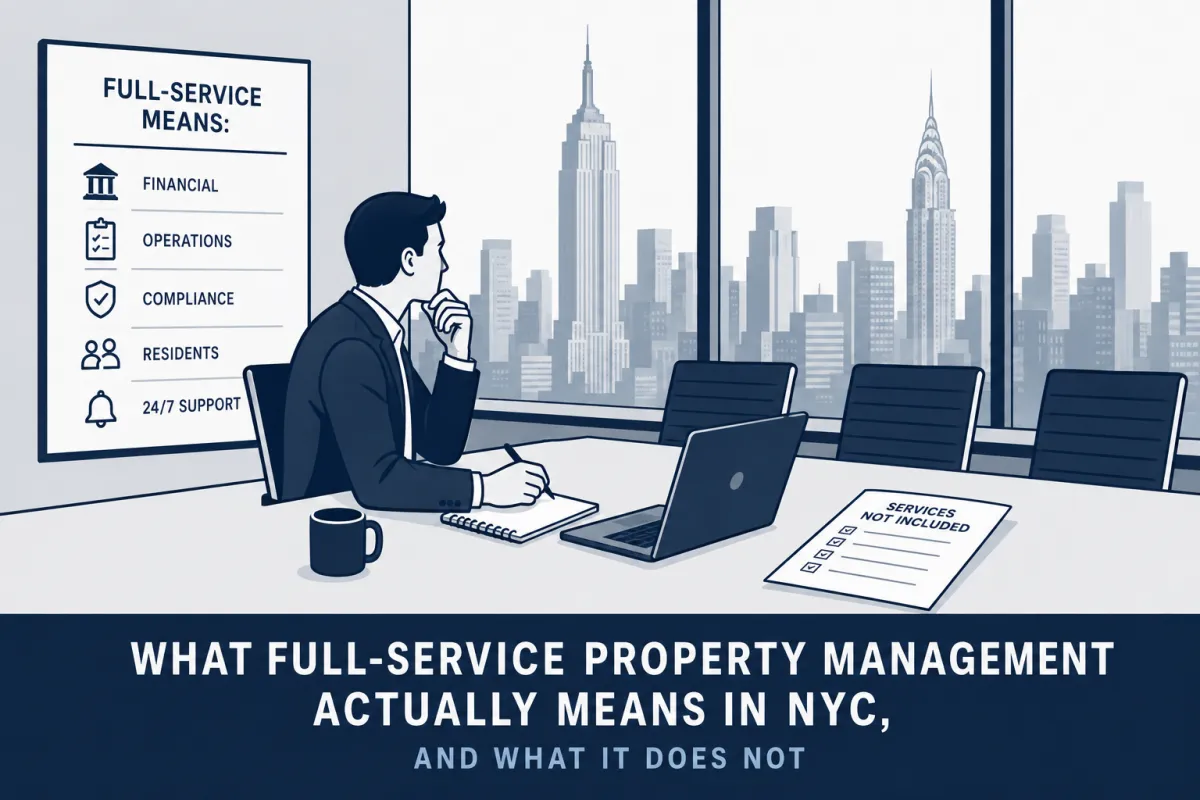
What Full-Service Property Management Actually Means in NYC, And What It Does Not
Almost every property management firm in New York City calls itself full-service.
It is right there on the website. In the proposal. In the pitch.
"We provide comprehensive, full-service property management for NYC co-ops and condos."
The problem is that "full-service" means something different to almost every firm that uses it.
And when a board signs a contract with a "full-service" firm and then discovers that three things they assumed were included are actually billed separately, the conversation that follows is never fun.
What Full-Service Theoretically Covers
In the most comprehensive version of the term, full-service property management means the firm handles:
Financial management: collecting maintenance, paying vendors, preparing financial statements and budgets
Compliance management: tracking regulatory deadlines, filing required documents, managing violations
Operational management: vendor oversight, maintenance coordination, repair management
Staff management: training and supervising the super or resident manager, handling HR-related matters for building employees
Board support: meeting preparation, agenda and minutes, governance advisory
Resident relations: handling complaints, applications, move coordination
Emergency response: 24/7 availability for building emergencies
That is genuinely full-service.
Most firms that call themselves full-service deliver some version of this list. Very few deliver all of it, all the time, without additional charges.
What "Full-Service" Frequently Does Not Include
Project management on capital work.
When your building undertakes significant repair or renovation work, many "full-service" firms charge a separate project management fee. This is often a percentage of the project cost and can add up to tens of thousands of dollars on a major project.
After-hours emergency response.
Some firms treat true 24/7 emergency response as included. Others have a dedicated emergency line that connects to an answering service, with actual response incurring additional cost. Others define "emergency" narrowly enough that most situations do not qualify.
In-person support beyond a defined site visit schedule.
If your building needs additional visits, during an active capital project, after a significant incident, or during a crisis period, those extra visits may be outside the base scope.
Compliance oversight and remediation.
While building compliance services are included under a full-service agreement, the property management firm typically passes through that cost to the co-op.
The same goes for compliance remediation, which is typically handled by a third-party company specializing in removing violations. That cost is also passed on to your building and is not included under the full-service management agreement.
Transaction-specific services.
Alteration applications, subletting approvals, lease transfer coordination. Each of these typically carry a per-transaction fee that is not reflected in the monthly base.
Back-Office vs. Full-Service: A Real Distinction
Some firms offer what is sometimes called back-office or administrative-only management. They handle the financial and administrative functions, accounting, reporting, compliance tracking, but do not provide on-site oversight or active vendor management.
This model can work well for self-managed buildings that have strong on-site staff and a board willing to handle operational matters directly. It is significantly different from full-service management.
The confusion happens when firms present a primarily back-office model using full-service language. Boards sign thinking they are getting comprehensive operational support, and discover they are doing more of the work themselves than they expected.
The Question That Cuts Through the Ambiguity
Before you sign anything with any firm that describes itself as full-service, ask this question:
"Can you give me a complete list of every service that falls outside our base fee, and what each one costs?"
The answer to that question tells you more about what "full-service" actually means at this firm than anything in the proposal.
A firm that answers it completely, specifically, and without hesitation is a firm that is confident in what they offer. A firm that is vague, defensive, or slow to produce that list is telling you the list is longer than they want to show you.
If your board is evaluating firms and wants help cutting through the language to understand what you are actually buying, let's connect.
Back to Property Management NYC


