How to Know If Your NYC Building Is Ready for a New Property Manager
Most boards that come to us know they are unhappy with their current property management situation.
What they are less sure about is whether they are ready to do something about it.
Not whether they have the will. Whether the timing is right. Whether the building is in a position to handle a search and a transition without things getting harder before they get better.
Those are real questions. And the honest answer is that timing matters.
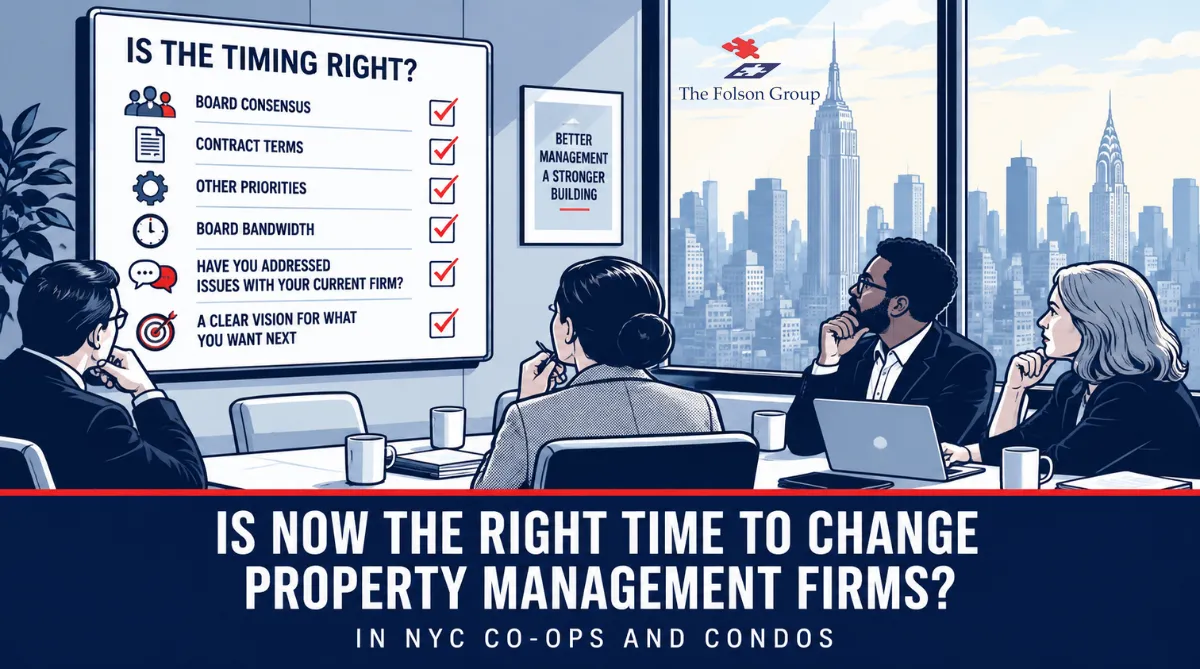
Signs the Timing Is Right
You have board consensus, not just board frustration.
A property management search launched over internal disagreement is a harder search. Boards that are divided about whether to make a change, or split on what they want in a new firm, tend to have a slower, messier process.
Before you start, make sure the board agrees on the core issues with the current firm and shares a general sense of what a better situation looks like.
Your contract allows it.
Review your current management contract before you do anything else. What is the required notice period to terminate? Are you still under the initial agreement which can be one to three years.
Some boards prefer to wait until the annual contract renewal while other boards go with the early termination clause no matter when the renewal date is. It’s really up to you and how urgent a change is for your board.
You are not in the middle of something you cannot pause.
If your building is deep in a capital project, navigating a significant legal matter, or managing a complex compliance issue, switching property managers mid-stream may feel that it adds risk.
While this feeling is common and quite understandable, most property managers are thrown into situations all the time. Most property managers are used to taking over messy situations.
You have the board bandwidth to run a real process.
A property management search is not a two-meeting commitment. It takes real hours from the people involved. If your board is already stretched thin, launching a search that cannot get the attention it deserves is a setup for a bad outcome.
If bandwidth is the constraint, outside help, someone who carries most of the process weight, can make a meaningful difference.
Signs the Timing Might Not Be Right, Yet
You have not directly addressed the problems with the current firm.
If your board has been internally frustrated but has not actually raised the issues with the management firm directly, a search may be premature.
Not because the firm deserves infinite chances. But because you owe it to yourselves to know whether the problems are fixable before committing to the full weight of a search and transition.
A direct, professional conversation with the firm about performance, especially if documented, gives you clarity. If things improve, you have your answer. If they do not, you have a clear record of having tried.
The board is not aligned on what you want next.
Boards that start a search without a shared vision of what they are looking for tend to make compromised decisions. Knowing what you need, in terms of firm size, service model, communication style, and building type expertise, before you start talking to candidates makes the evaluation dramatically cleaner.
The building is genuinely not ready for the disruption.
Transitions are operationally demanding. There is a 30-to-90-day period where two firms are involved and nobody fully owns the picture. If your building is in a vulnerable moment, a pending special assessment, a strained relationship with staff, an active enforcement matter, adding transition chaos may not serve your residents well right now.
What Getting Ready Actually Looks Like
If the timing is not quite right, that does not mean doing nothing.
It means using the time productively.
Document the performance issues with your current firm in writing. Get your governing documents and financial records organized. Start an internal conversation about what the board is looking for. Consult with someone who knows the market so you understand your options before you need to act on them.
A board that starts a search prepared, with clarity on what it needs, consensus on why it is searching, and a clean operational picture, runs a faster, better search and makes a stronger hiring decision.
If your board is trying to figure out whether now is the right moment, let's talk it through. Sometimes the answer is yes. Sometimes it is not quite yet. Either way, knowing which one is worth a conversation.
Back to Property Management NYC


