The Difference Between a Board That Runs the Building and One That Lets the Building Run Them
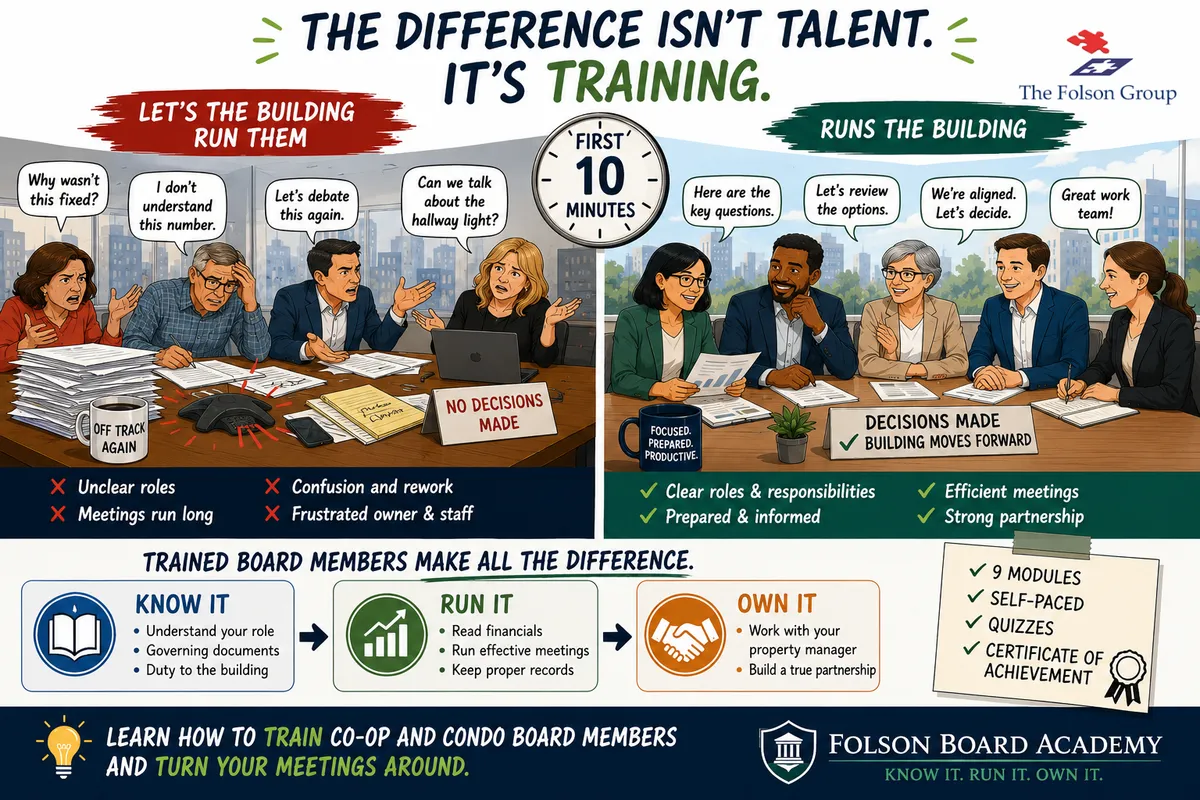
You can tell within the first ten minutes of a board meeting whether the board runs the building or the building runs them.
The boards that run things show up prepared. They move through the agenda. They ask sharp questions and make decisions. The other kind? They spend forty-five minutes debating something that was already approved, argue about a repair they do not understand, and leave without resolving anything.
If you manage co-ops or condos, you have seen both. And you know which one you would rather work with.
The difference is not talent or intelligence. It is training.
They Know What Their Job Actually Is
The single biggest source of friction between boards and property managers is role confusion. Board members who do not understand their own responsibilities start doing the property manager's job. They direct staff. They call vendors. They make promises to shareholders that nobody agreed to.
Trained board members understand the line. They set direction. They approve budgets. They make policy decisions. And they let the property manager handle operations. This alone eliminates half the tension in the relationship.
Knowing how to train co-op and condo board members on this distinction is one of the highest-value things a property management firm can do.
They Read Their Financials Before the Meeting
Nothing slows a board meeting down faster than a treasurer who does not understand the financial statements. Or worse, a board member who sees a number they do not recognize and turns it into a thirty-minute investigation in real time.
Boards that have been trained know what they are looking at. They understand the difference between operating expenses and capital reserves. They know how to spot a variance that matters versus one that does not. They come to the meeting with questions, not confusion.
For property managers, this means shorter meetings, fewer follow-up calls, and a board that actually trusts the numbers.
They Run Meetings That Respect Everyone's Time
A board meeting should not feel like an open forum. It should have an agenda, a structure, and a clear path to decisions. Trained boards understand this. They know how to keep discussion focused. They know when to table something for later. They know the difference between a discussion item and an action item.
This is not personality. It is a skill. And it is something that can be taught.
They Know How to Work With Their Property Manager
The best boards treat their property manager as a partner, not a vendor and not an employee. They communicate through proper channels. They understand what is reasonable to expect and what is outside the scope. They give feedback without micromanaging.
This does not happen by accident. It happens when someone takes the time to explain how the relationship is supposed to work.
What Know It. Run It. Own It. Actually Covers
We built the Know It. Run It. Own It. course at Folson Board Academy around exactly these gaps. The name is not random. It maps to three phases of board readiness.
Know It covers the foundation: what you signed up for, who is responsible for what, your governing documents, and your duty to the building.
Run It covers execution: reading your financial statements, running effective meetings, and keeping proper records.
Own It covers the working relationship: how to partner with your property manager so the building actually moves forward.
Nine modules. Self-paced. Quizzes to make sure it sticks. A Certificate of Achievement at the end. Built from 13 years of advising boards across New York City.
For property managers wondering how to train co-op and condo board members without adding hours to your own workload, this is the answer.
The First Ten Minutes Tell You Everything
That board meeting where you can tell in the first ten minutes whether things will go well or sideways? Training is what tips it in the right direction. And the earlier it happens, the better for everyone.
See what Folson Board Academy can do for your boards at academy.thefolsongroup.com or thefolsongroup.com.


