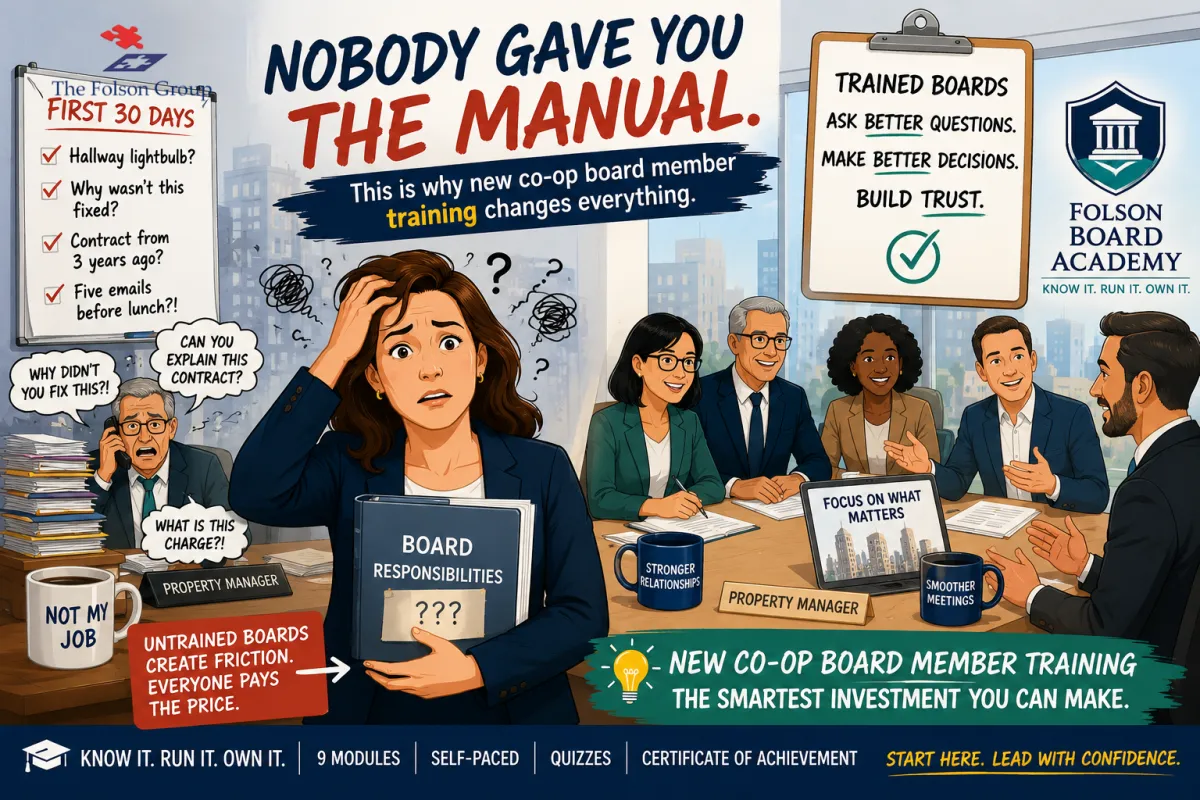
What Nobody Tells You When You Get Elected to a Co-op or Condo Board
Every property manager remembers the moment. A new board gets elected, introductions happen, and within a few weeks the calls start coming in. Not the productive kind. The kind where a brand-new board member wants to know why you haven't fixed something that was never your responsibility. Or questions a contract that was approved three years ago. Or sends you five emails before noon on a Monday about a hallway lightbulb.
It is not that they are difficult people. It is that nobody told them how any of this works.
What Actually Happens After a Board Election
When someone gets elected to a condo or co-op board in New York City, they are handed real responsibility overnight. They are now helping to govern a building worth millions of dollars. They are making decisions about budgets, contracts, insurance, capital projects, and building operations.
And in almost every case, they receive zero formal training.
No orientation. No walkthrough of the governing documents. No explanation of what a property manager actually does versus what the board is responsible for. They show up at their first meeting and start voting on things they do not fully understand.
This is not a criticism of board members. Most of them are smart, busy professionals who volunteered their time. But volunteering does not come with a manual. And the gap between getting elected and actually understanding the role creates problems that land directly on the property manager's desk.
The Real Cost to Property Managers
If you manage co-ops or condos, you already know what an untrained board looks like from the inside.
It looks like board members who confuse governance with operations and start directing staff. It looks like meetings that run two hours longer than they should because nobody knows how to set an agenda. It looks like financial questions that could have been answered by reading the monthly report, except nobody knows how to read the monthly report.
The result is friction. Not the productive kind that comes from engaged oversight, but the exhausting kind that comes from confusion. Your team spends more time explaining, more time managing expectations, and more time putting out fires that should not have started.
Over time, this erodes the relationship. The board feels like the property manager is not responsive enough. The property manager feels like the board does not respect their expertise. And the building suffers because everyone is too busy being frustrated to focus on what actually matters.
New co-op board member training is not a luxury. It is the thing that prevents this cycle from starting in the first place.
Why the Smart Firms Are Investing in Board Education
The property management firms that are growing in this market have figured something out. The best way to improve the client relationship is not to work harder. It is to help the client understand their own role better.
When board members are trained, they ask better questions. They understand the difference between their job and yours. They come to meetings prepared. They read their financials before the meeting, not during it. They know what the governing documents say and they stop expecting you to interpret them on the fly.
This does not just reduce friction. It builds trust. A board that understands what good property management looks like is a board that can actually appreciate what your firm does. And a board that feels confident in their own role is far less likely to micromanage yours.
For firms entering or expanding in the New York City co-op and condo space, offering new co-op board member training as part of your service package sends a clear message. It says you are not just managing buildings. You are investing in the people who govern them.
What Folson Board Academy Was Built For
This is exactly why we created Folson Board Academy. After 13 years of advising co-op and condo boards across New York City, Mark Foley and I saw this gap up close in every single engagement. The boards that struggled were not the ones with bad buildings or bad budgets. They were the ones where nobody had ever explained the basics.
Our course, Know It. Run It. Own It., is a 9-module, self-paced program that gives board members the foundation they need from day one. It covers everything from understanding governing documents to reading financial statements to running effective meetings to working with a property manager. Each module ends with a quiz, and board members earn a Certificate of Achievement when they complete the course.
It was built for busy people. It was built from real experience. And it was designed so that property managers can hand it to a new board and say: start here.
Closing the Gap Before It Becomes a Problem
That board member who sent you five emails before noon on a Monday is not your enemy. They are someone who wants to do a good job and has no idea where to start. The question is whether you wait for the friction to build or give them the tools to get up to speed before the first meeting.
If you are a property management firm looking for a smarter way to onboard your boards, take a look at what we have built. You can learn more at thefolsongroup.com/academy or thefolsongroup.com.
It might be the easiest investment you make this year.


